
Connect
Ingest documents, databases, object stores, service logs, MCP resources and engineering systems through governed, module-gated connectors.
Platform
kiLM connects documents, engineering systems, operational data, knowledge graphs and local AI models inside a dedicated single-tenant environment — so teams can investigate, validate, simulate and act with evidence behind every decision.
One governed lifecycle
Every capability works together in one pipeline — not as isolated features. Data moves left to right; a governance rail holds underneath at every step.
Ingest documents, databases, object stores, service logs, MCP resources and engineering systems through governed, module-gated connectors.
Parse, chunk, classify sensitivity and resolve entities into consistent, versioned records with lineage preserved.
Build the trace graph and knowledge graph — connecting requirements, designs, parts, tests, suppliers and policy across domains.
Retrieve with vector, keyword, graph and visual signals; run change-impact, what-if and validation with citations behind every result.
Propose cross-system actions — tickets, record updates, workflows — each policy-checked and held for human approval before execution.
Capture feedback, evaluate answers and models, and promote or roll back improvements under governance.
Capabilities
Differentiation
Citations, source records, trace paths and policy verdicts back every result.
CAD, PLM, BOM, requirements, simulation, test, quality and field records — not just documents.
Ingest, extract, link, retrieve, reason, act, evaluate and improve — in a single controlled pipeline.
Actions are proposed, policy-checked, approved and audited — never unrestricted autonomy.
Dedicated single-tenant deployment with local-model and air-gap options.
See it in context
These are actual product surfaces. Each capability exposes its evidence, severity and approval trail — not a black box.
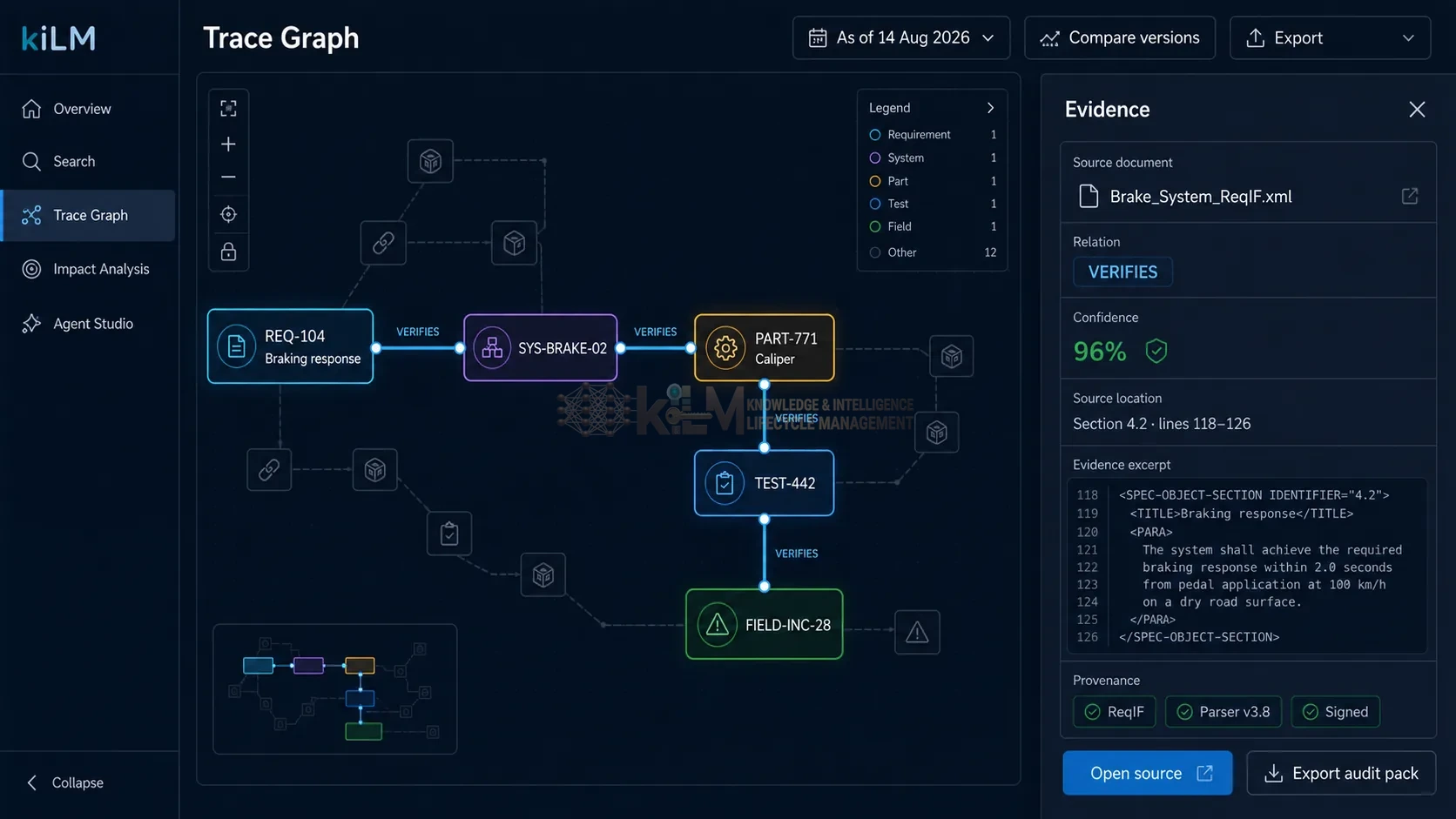
Follow any requirement to its design, test and field records, and open the source behind each edge.
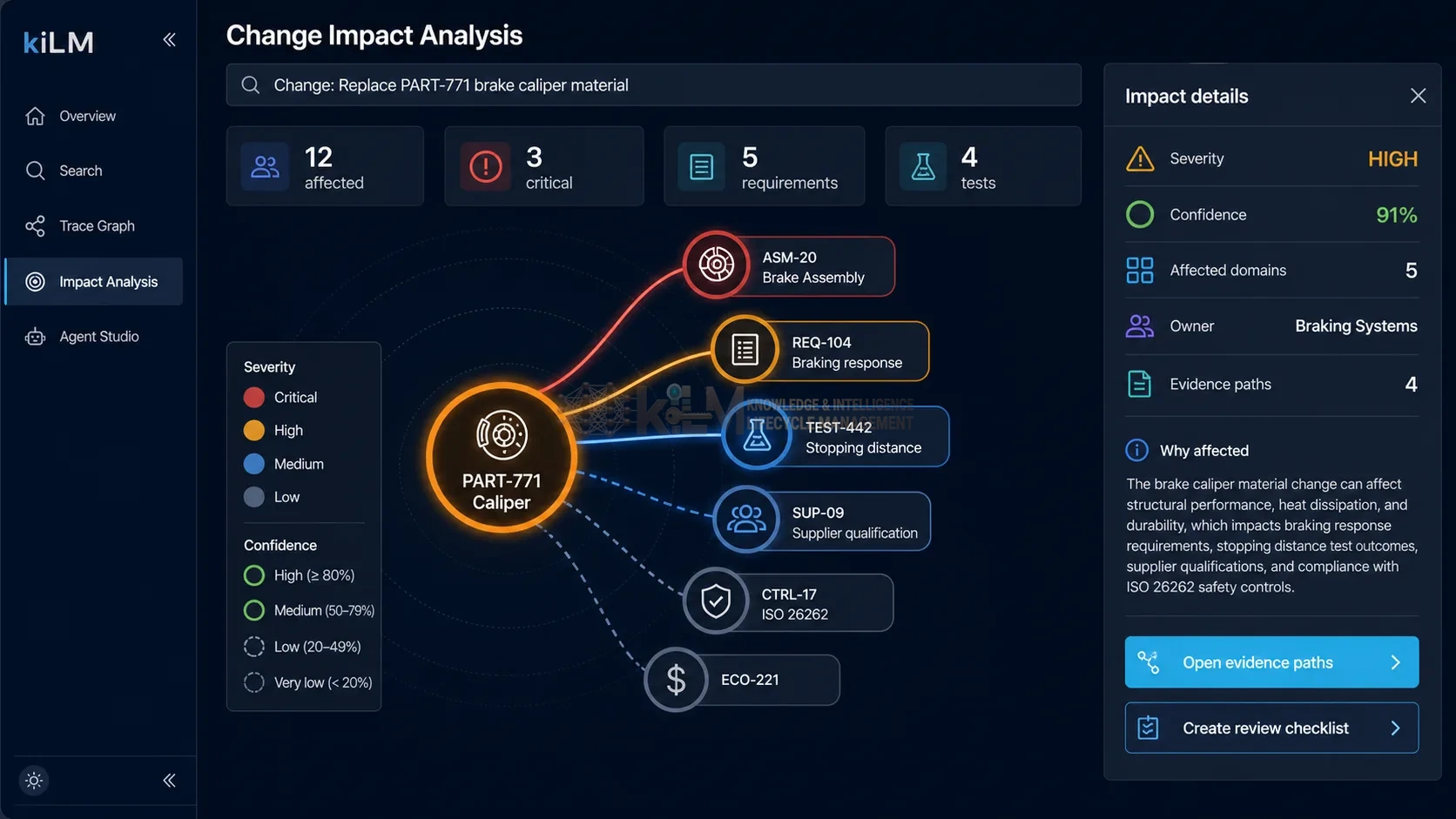
See what a change touches across domains, ranked by severity and confidence, before you approve it.
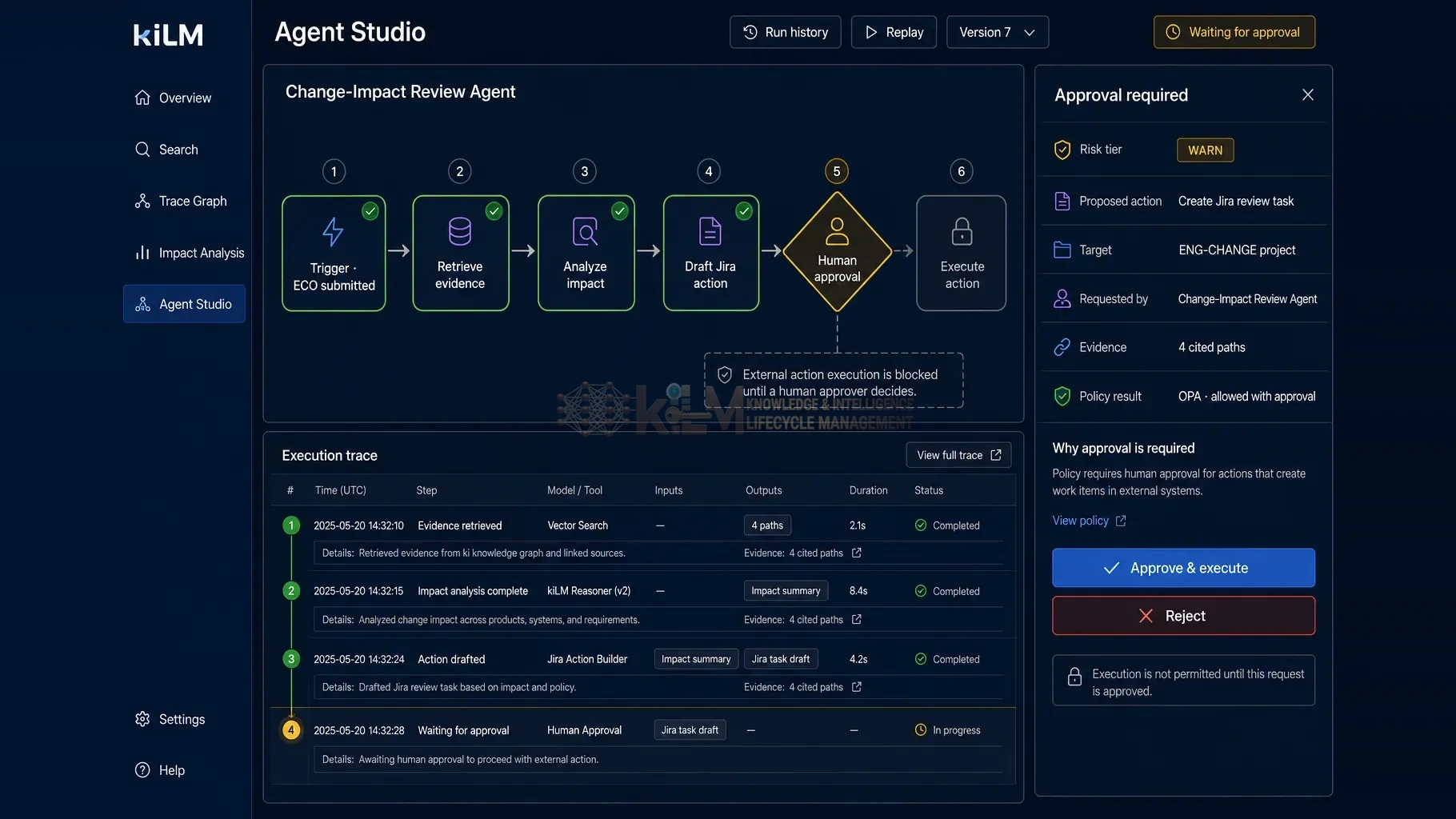
Watch a governed workflow propose an action, pass policy checks, and wait for human approval before it runs.
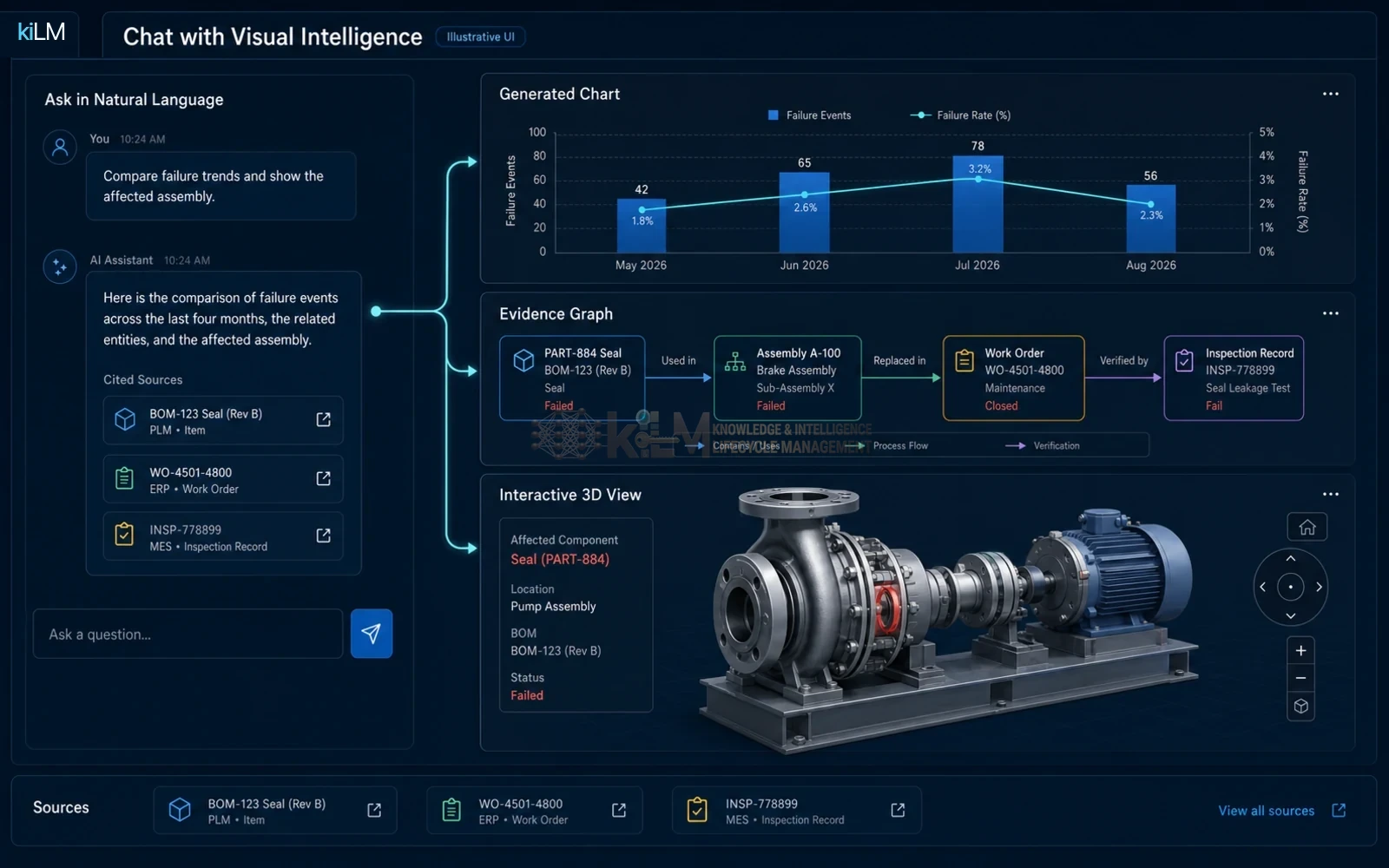
Ask in plain language and get a grounded, cited answer alongside the diagrams, scans and images kiLM matched by their visual content.
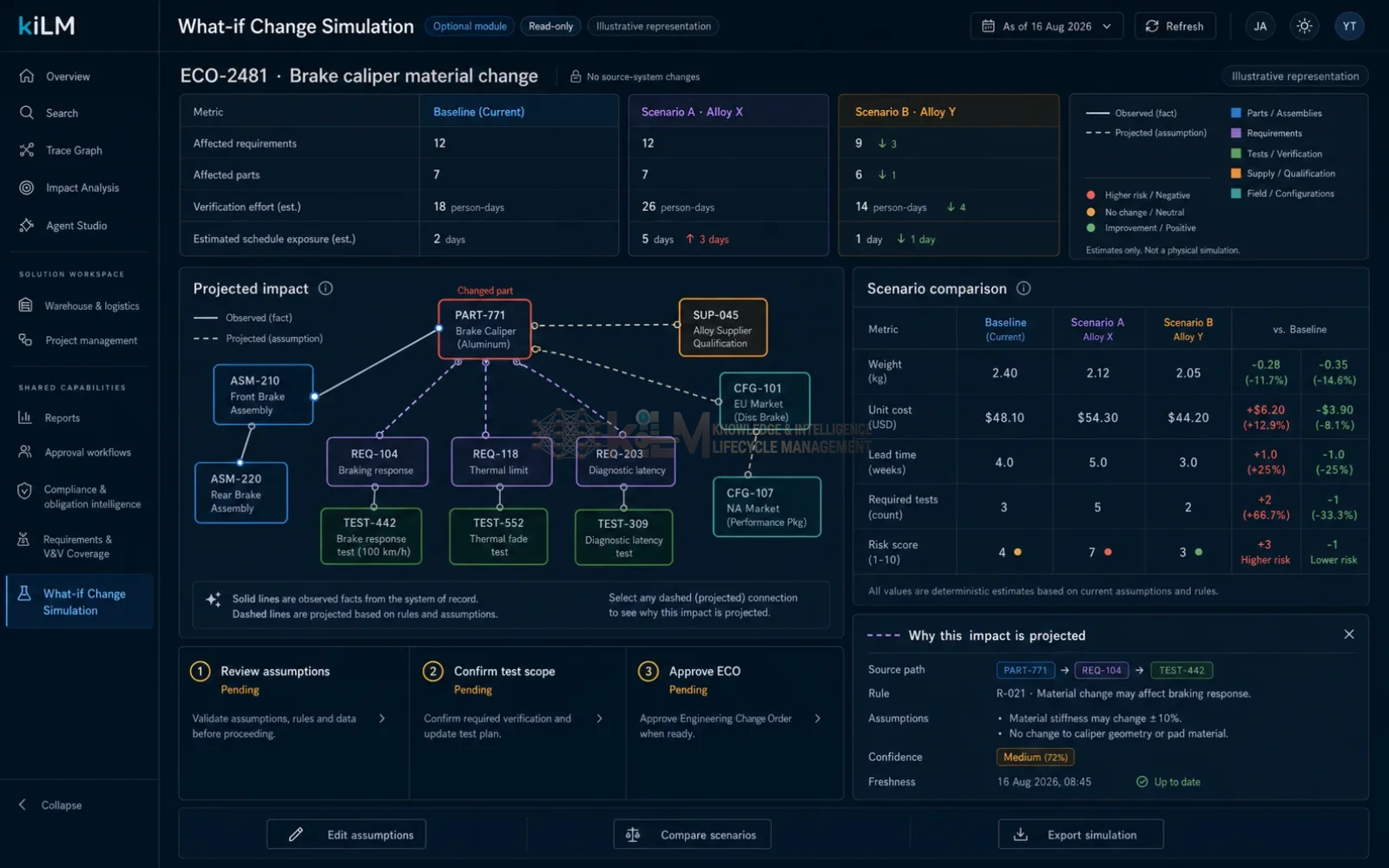
Model a proposed change against your governed data, compare alternatives, and see the regression checklist it would trigger — before you commit.
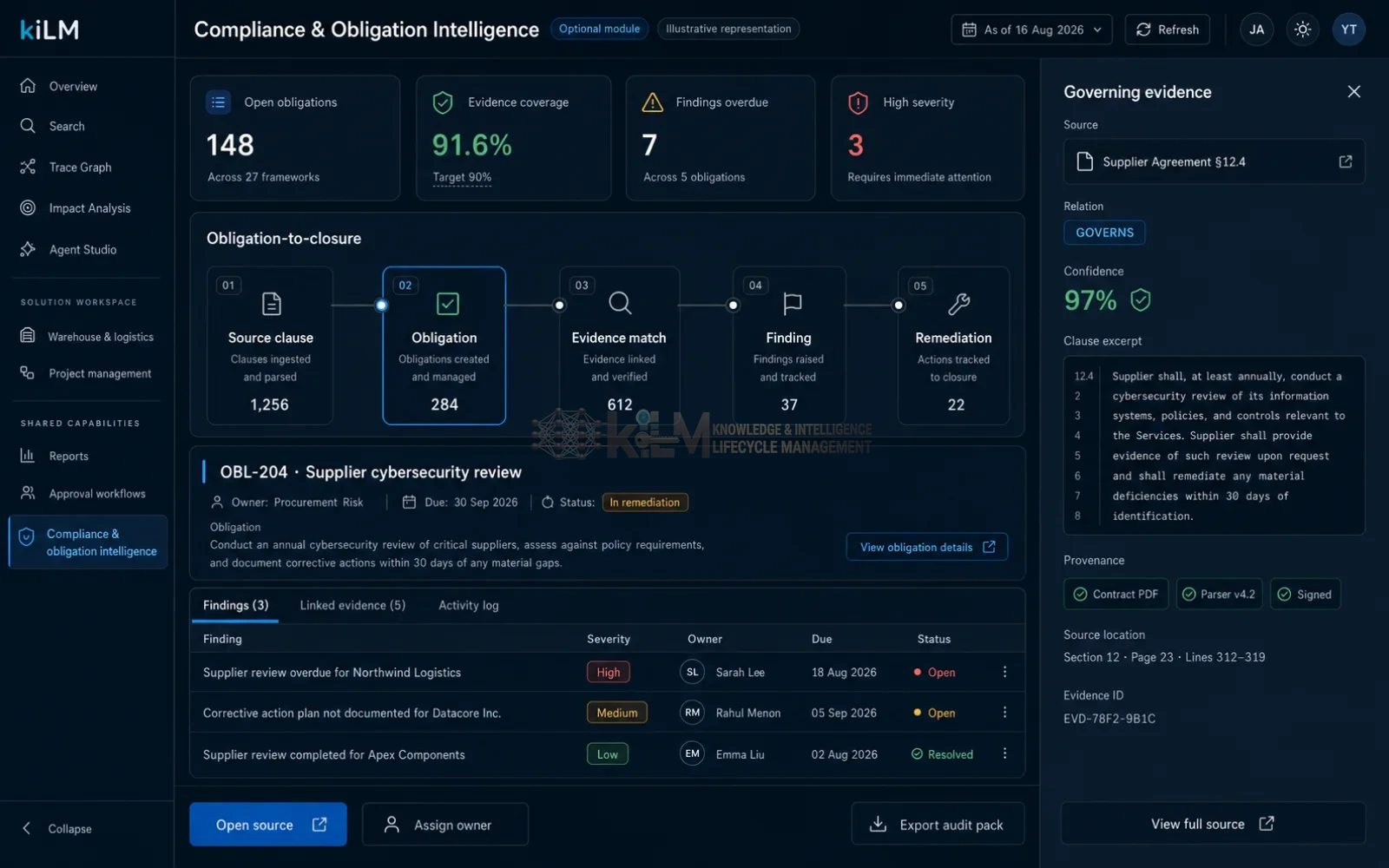
Watch a corpus against its obligations, file findings, and track each remediation to closure — every item linked back to its source clause.
Explore
A guided tour of everything under the Platform menu — skim each area here, then open the full page whenever you want the detail.
The connectors, protocols, and cloud services kiLM ingests — each module-gated.
Read the full page →Sensitivity classes, field-level encryption, cascade erasure, and a full audit trail.
Read the full page →A self-contained stack you host yourself, from a CPU-only trial to a GPU production cluster.
Read the full page →The same image set in every topology — fully isolated, cloud, or hybrid.
Read the full page →Predictable licensing — the default stack uses only permissive components.
Read the full page →Federates to your identity provider — OpenID Connect, SAML 2.0, SCIM 2.0, and LDAP / Active Directory.
Read the full page →Model-agnostic by design — run open-source, open-weight, frontier, or paid models.
Read the full page →Ownership & IP
As between you and POLYCRACY (kiLM's maker), POLYCRACY does not claim ownership of your inputs or your customer-specific outputs — the governed corpus, the intelligence derived from it, and models fine-tuned or distilled on your data. POLYCRACY's own intellectual property is the kiLM platform itself. This allocation is subject to the licenses of any third-party or open-weight base models, third-party source-document rights, your customer agreement, and applicable law.
Tell us your stack and the decision you need to support. We'll scope a governed starting point — on infrastructure you choose.
Tell us about your use case. We review every request and a member of our team will be in touch within one business day.