Use Cases
Decisions kiLM Helps Your Teams Make
The foundation of the kiLM platform, together with Agent Studio, supports a growing set of governed decision and advisory workflows — and you can extend or customize them for your own business processes.
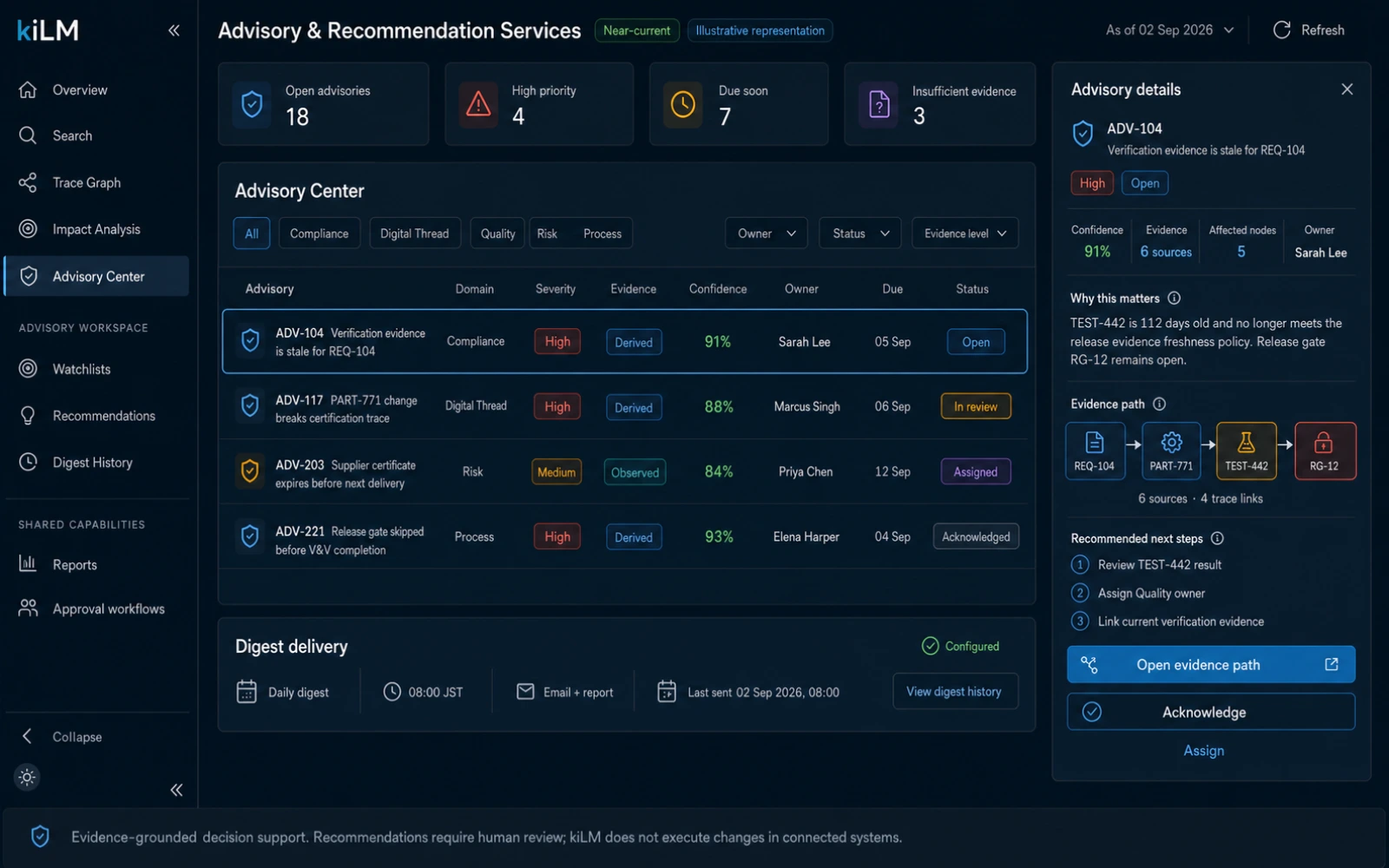
Advisory & Recommendation Services to Users
Proactive, evidence-backed advisories and recommendations delivered to your users through emails and reports.
How kiLM enables it
kiLM continuously watches your governed corpus and connected systems, then compiles advisories — compliance gaps, knowledge-gap and Digital Thread breaks, quality / V&V risks, foreseeable risks, and business-process or company-rule deviations — into an Advisory Center, watchlists and scheduled email digests, with every recommendation cited to its evidence.
Why kiLM is better placed
Every advisory is generated inside your boundary from your own systems-of-record and delivered with its citations, so recommendations are actionable and auditable — reaching the right users proactively through email and reports instead of waiting for someone to run a query.
Possible features
- Compliance and regulatory adherence advice.
- Digital Thread and knowledge-gap detection.
- Quality / V&V assurance guidance.
- Foreseeable risk identification.
- Business process and company-rule conformance.
- Advisory Center, watchlists, email digests and evidence-backed reports.
End-to-End Digital Thread & Certification Readiness
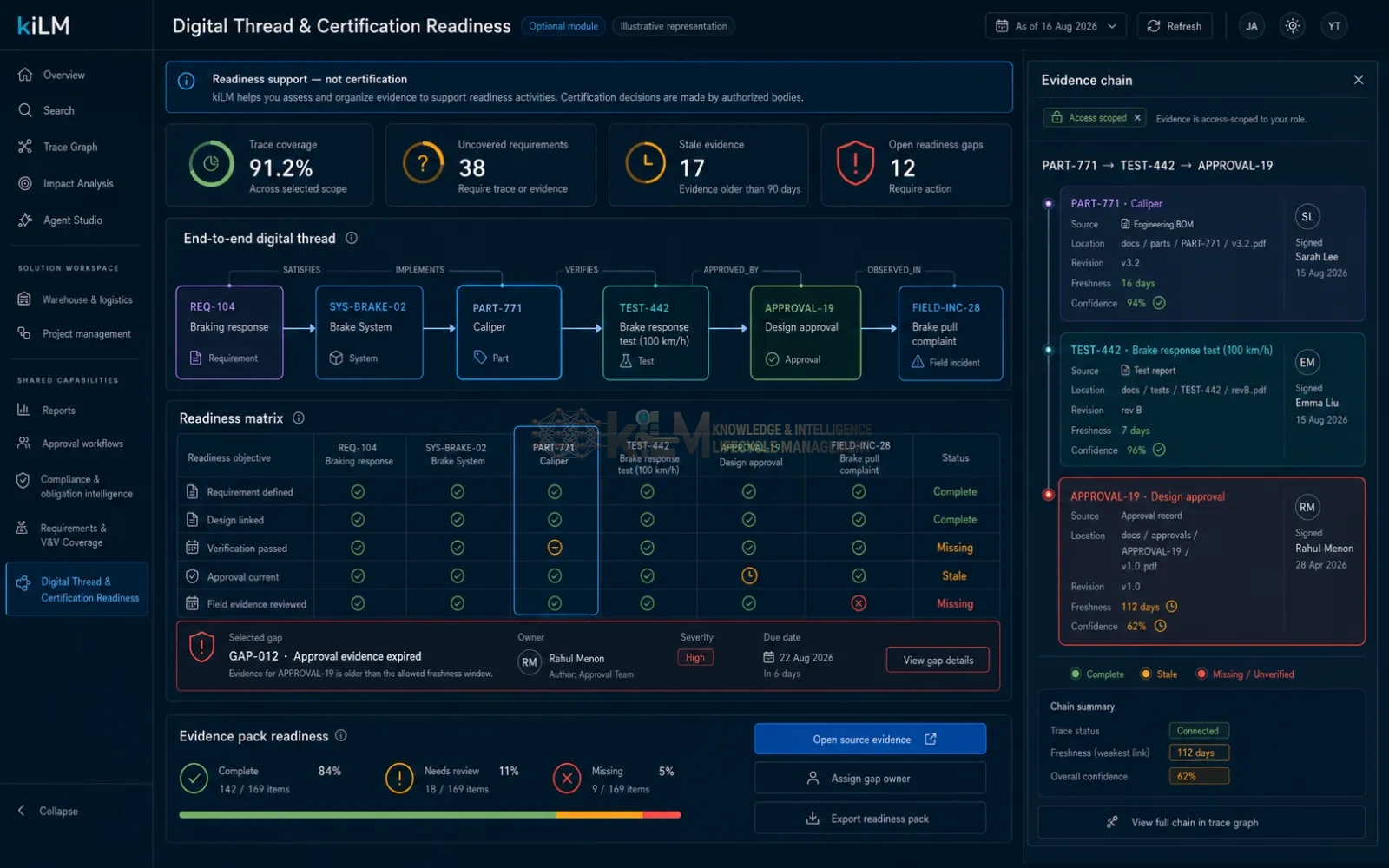
Trace every requirement, design, part, test and supplier record end-to-end across your systems, so a certification or audit dossier — and any gaps in it — can be assembled on demand.
How kiLM enables it
kiLM links requirements, designs, parts, tests, suppliers and field records into one governed trace graph across your connected systems, then assembles a certification or audit dossier — with every artifact cited to its system-of-record — on demand.
Why kiLM is better placed
The thread is reconstructed from your own systems inside your boundary, so coverage and gaps are evidence-backed rather than stitched together in spreadsheets that drift the moment a source changes.
Possible features
- On-demand certification / audit dossier with per-artifact provenance.
- Live traceability from requirement to design, test, part and field return.
- Gap and orphan detection across the thread, flagged for review.
Part / Design Change Impact Analysis
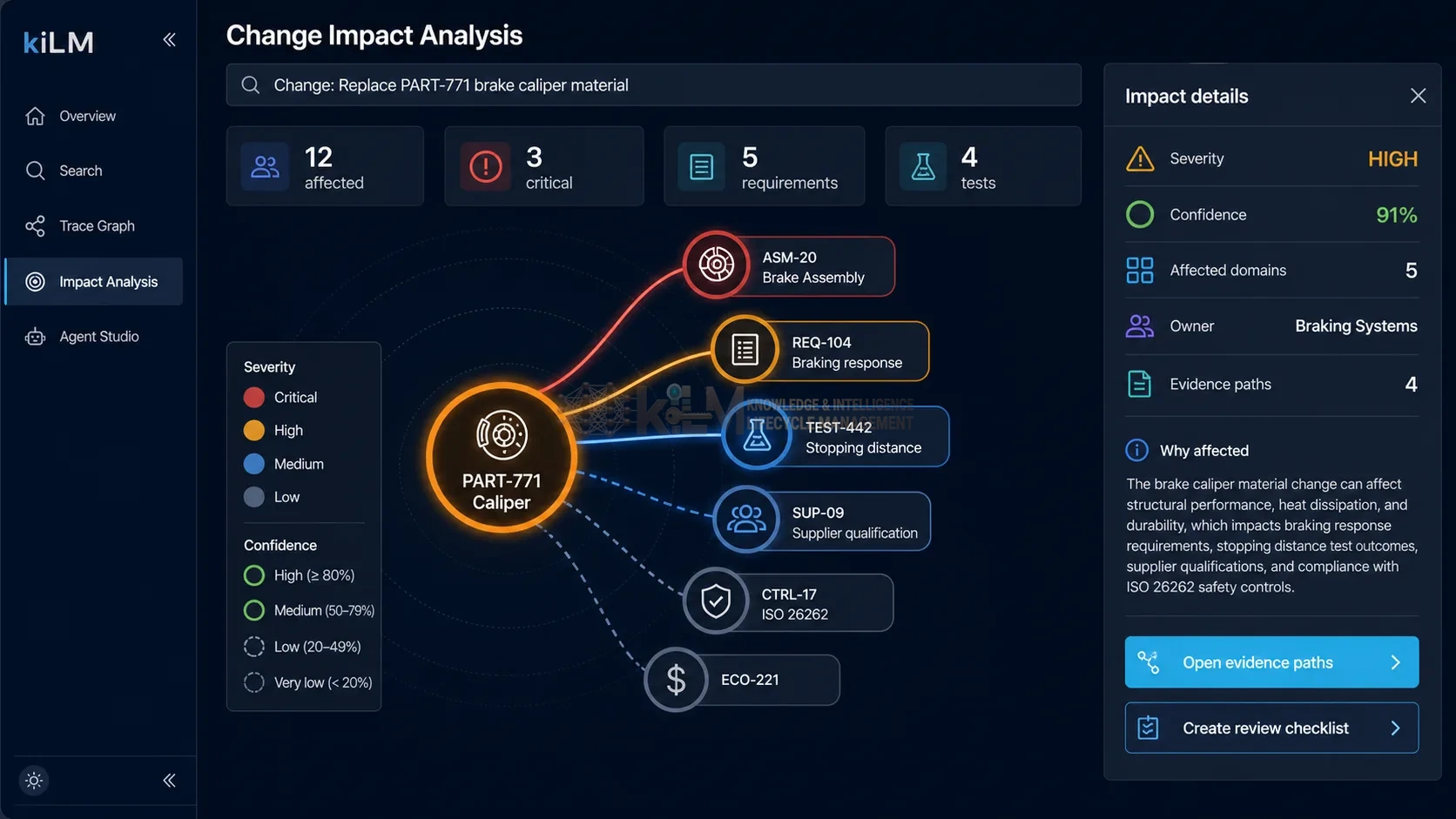
See what a part or design change ripples into — which assemblies, requirements, tests, suppliers and BOMs are affected — before you approve it.
How kiLM enables it
Given a changed part, requirement or parameter, kiLM walks the trace graph, BOM, knowledge graph and policy across every connected domain and returns a de-duplicated impact graph with per-node severity and confidence.
Why kiLM is better placed
The blast radius is computed from your governed data and scoped to what each reviewer is entitled to see — read-only, so an ECO/ECR review rests on the real dependency web, not tribal memory.
Possible features
- Cross-domain blast-radius for any part, requirement or parameter change.
- Per-node severity and confidence, with a what-if checklist.
- Access-scoped, read-only review — reviewers see only entitled domains.
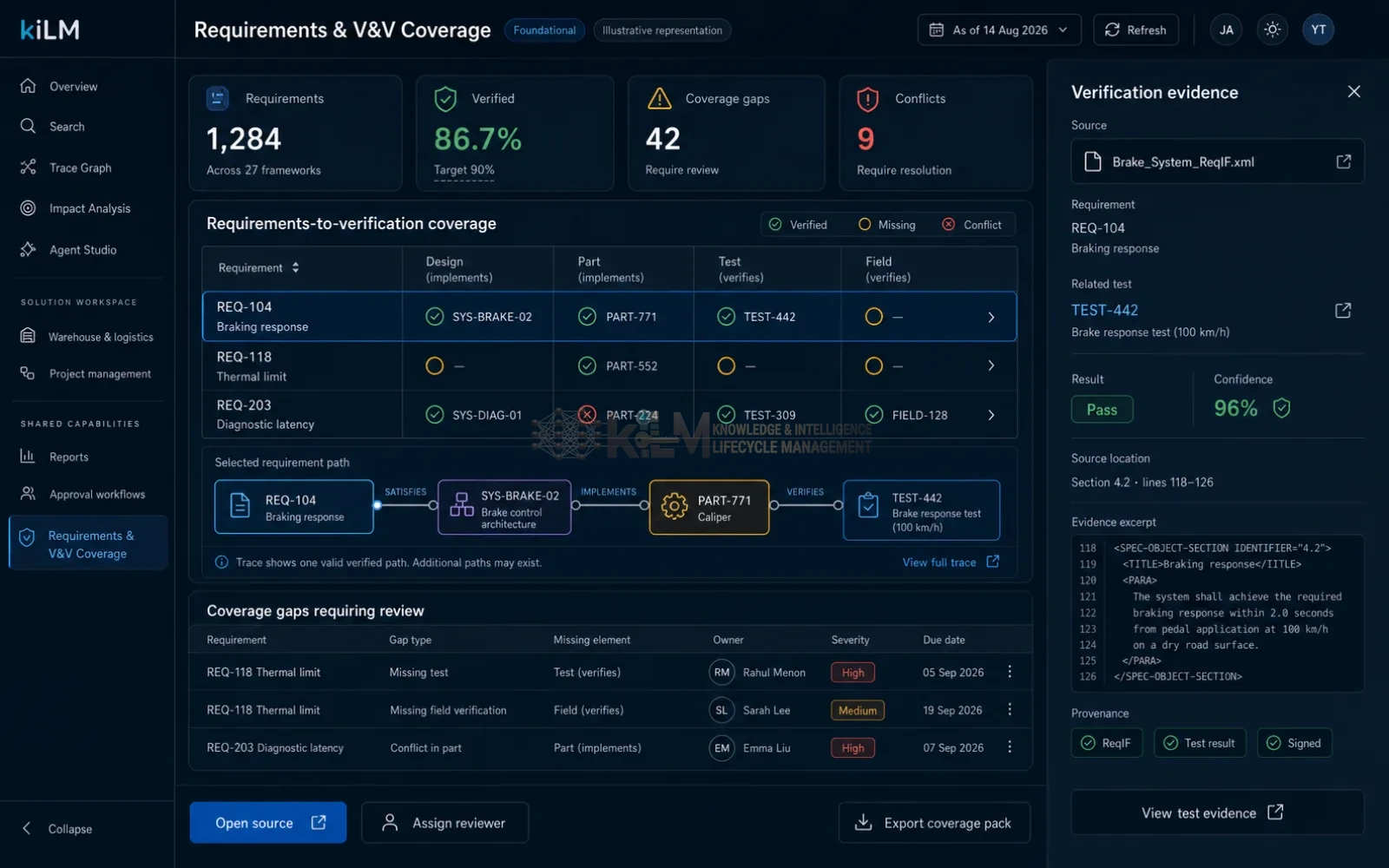
Cross-System Requirements & Specifications Validation
Verify any requirement or specification against your enterprise systems-of-record, policy and provenance, so every claim is backed by an authoritative source.
How kiLM enables it
kiLM checks any requirement or specification against your enterprise systems-of-record, policy and provenance across systems, returning a verdict with the authoritative source behind every claim.
Why kiLM is better placed
Validation spans the systems where the truth actually lives — PLM, ALM, documents, test — instead of a single tool's silo, and every answer is cited or it refuses.
Possible features
- Cite-or-refuse verdicts with links to the governing source.
- Cross-system checks over PLM, ALM, requirements and test data.
- Conflict and ambiguity flags where sources disagree.
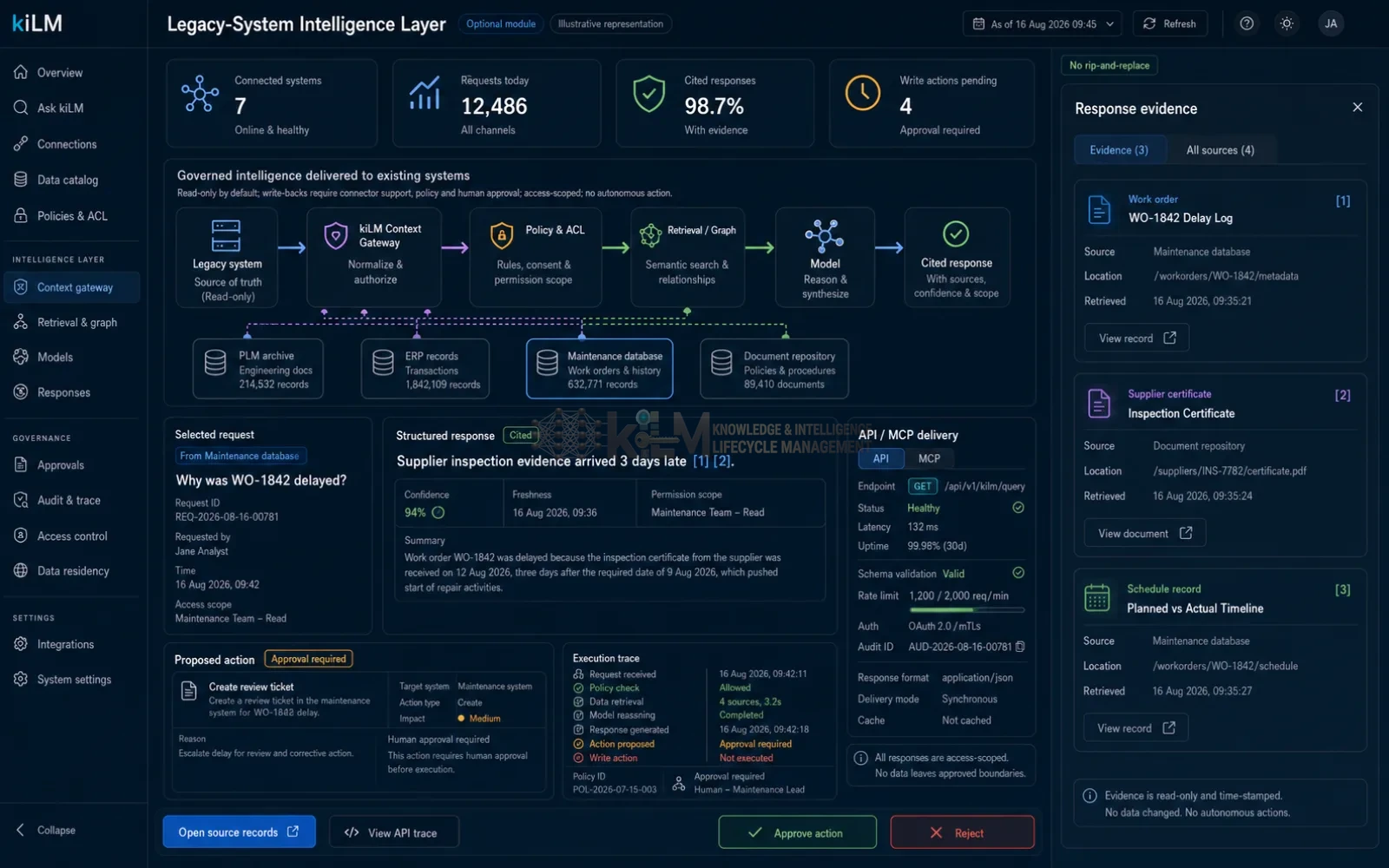
AI Intelligence Layer for Legacy Systems
Serve governed, cited answers and structured records back to your existing systems-of-record through the kiLM API and MCP gateway — so legacy tools gain grounded intelligence without a rip-and-replace.
How kiLM enables it
Through the kiLM API and MCP gateway, kiLM serves governed, cited answers and structured records back into your existing systems-of-record — adding an intelligence layer without a rip-and-replace.
Why kiLM is better placed
Legacy tools gain grounded, permissioned intelligence in place, so value arrives without migration risk and every response stays inside your boundary.
Possible features
- Cited answers and structured records exposed via API / MCP.
- Drop-in intelligence for existing PLM, ERP and ticketing tools.
- Policy- and permission-aware responses, fully audited.
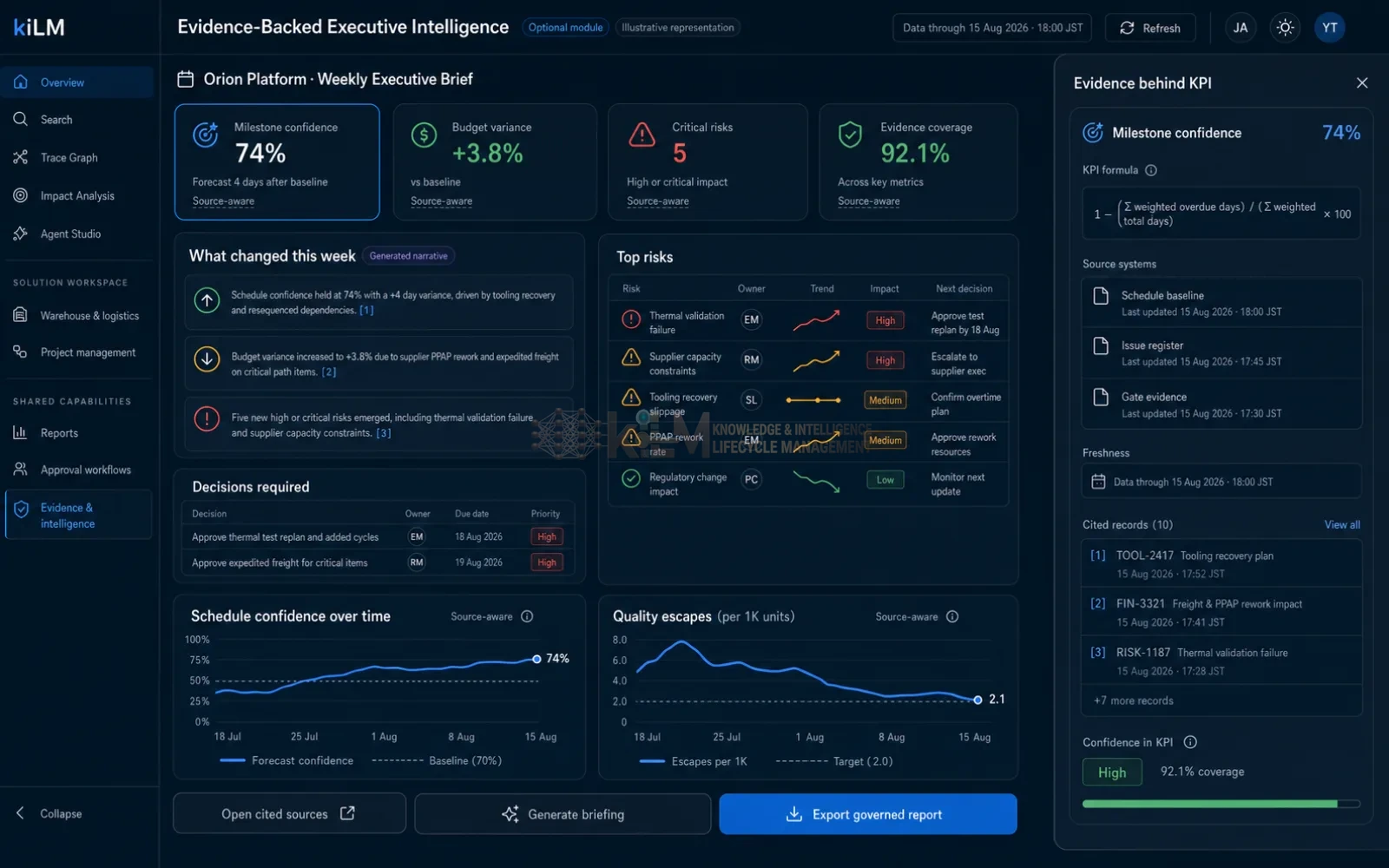
Evidence-Backed Executive Intelligence
Produce scheduled, source-cited briefings for leadership — assembled from your corpus, metrics and knowledge graph, with every figure traceable to its system-of-record.
How kiLM enables it
kiLM produces scheduled, source-cited briefings for leadership, assembled from your corpus, metrics and knowledge graph, with every figure traceable to its system-of-record.
Why kiLM is better placed
Executives get decision-grade summaries where each number can be opened to its source, so the brief is trusted rather than a hand-assembled slide of unverifiable figures.
Possible features
- Scheduled leadership briefings from governed data.
- Every figure traceable to its system-of-record.
- Narrative plus metrics, assembled inside your boundary.
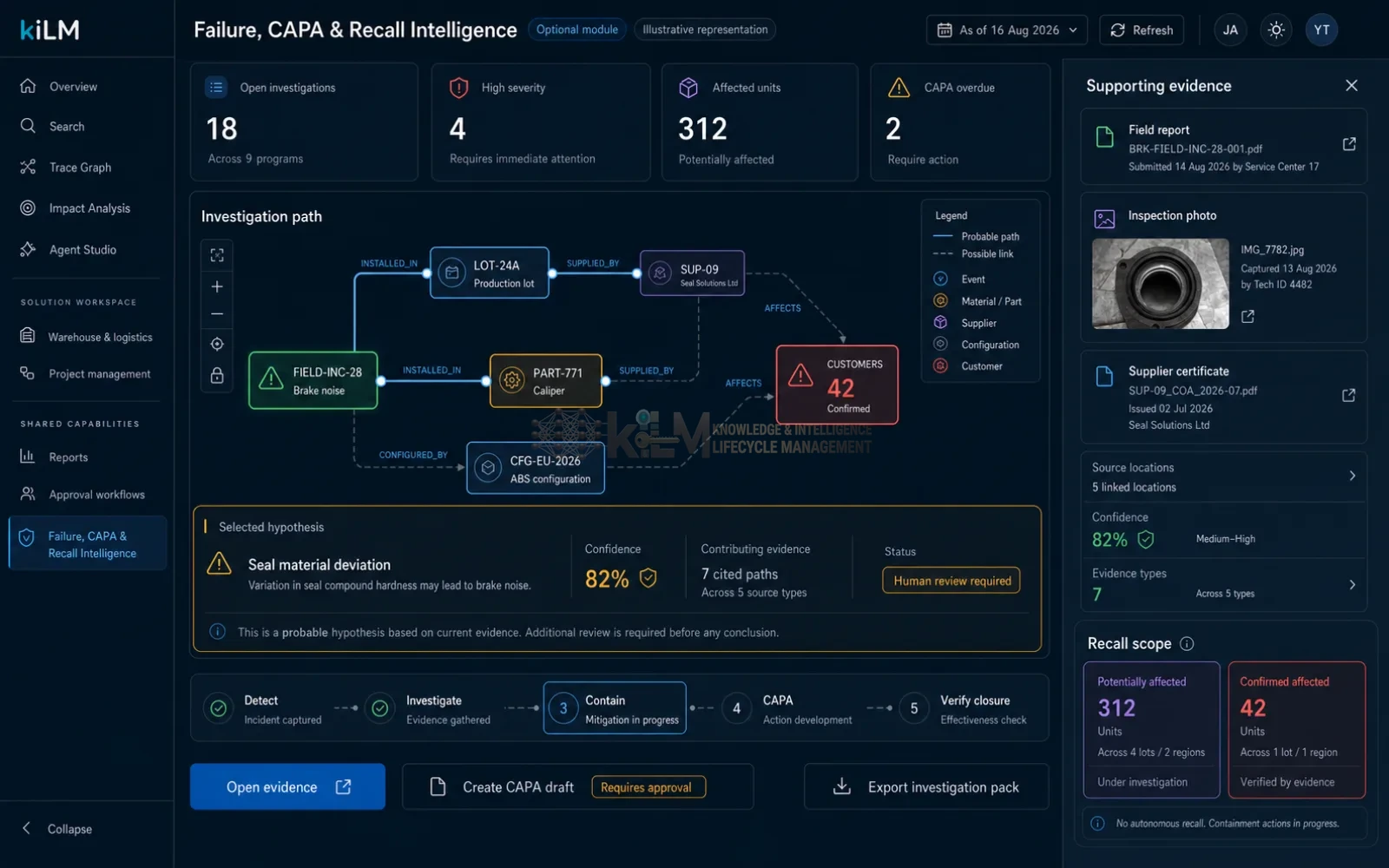
Failure, CAPA & Recall Intelligence
Trace a failure through manuals, field reports and the BOM to a probable root cause — then drive the CAPA and scope any recall by affected lot, part and configuration.
How kiLM enables it
kiLM traces a failure through manuals, field reports and the BOM to a probable root cause, then helps drive the CAPA and scope any recall by affected lot, part and configuration.
Why kiLM is better placed
Root-cause, corrective action and recall scoping share one governed graph, so the containment boundary is derived from real part / lot / configuration links rather than a conservative over-recall.
Possible features
- Guided traversal to a probable root cause with supporting evidence.
- CAPA drafting and tracking through to closure.
- Recall scoping by affected lot, part, configuration and customer.
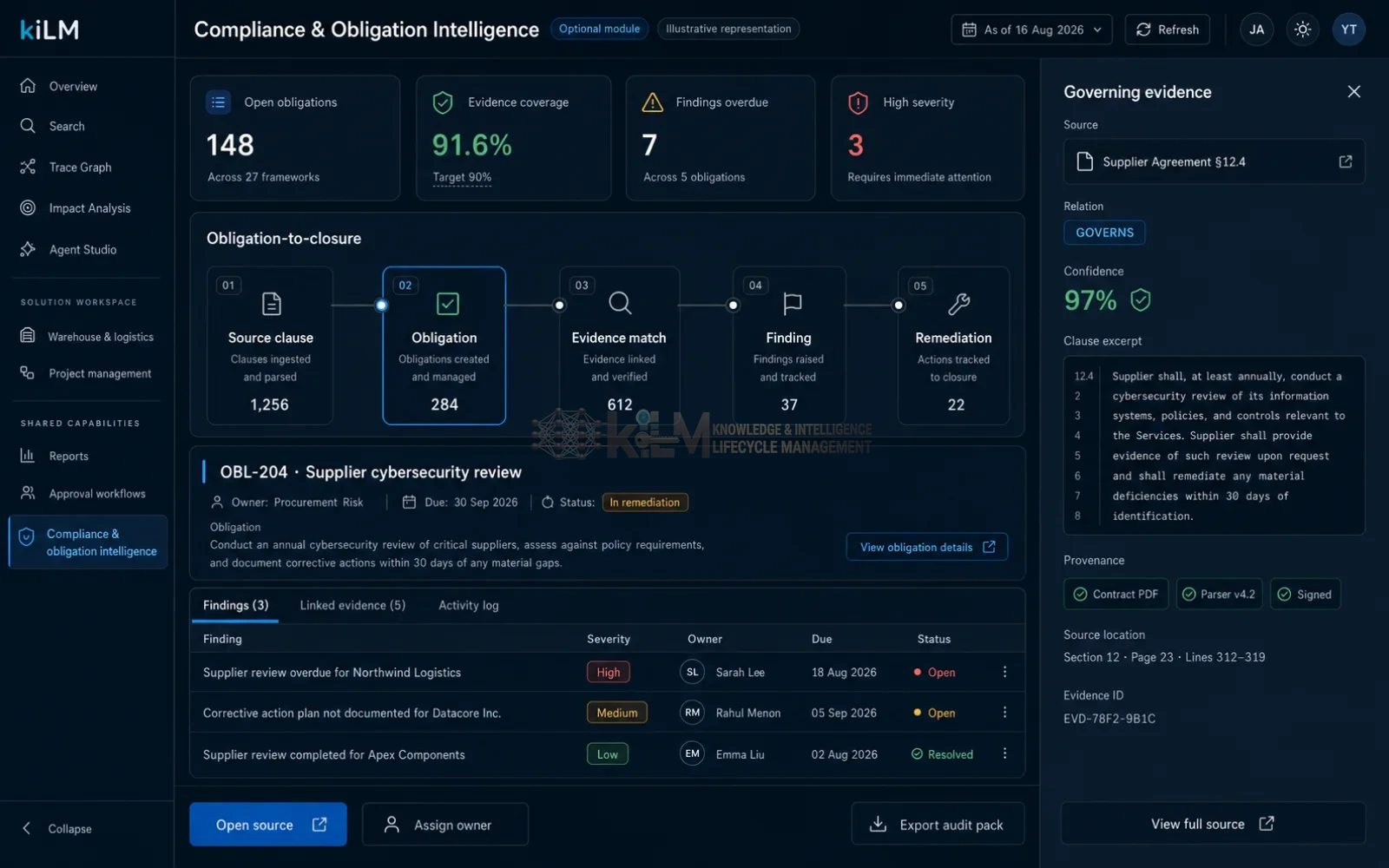
Continuous Compliance & Obligation Scanning
Continuously watch a corpus against its obligations, then file findings and track remediation through to closure.
How kiLM enables it
kiLM continuously watches a corpus against its obligations, files findings, and tracks remediation through to closure.
Why kiLM is better placed
Obligations are matched against your live evidence base inside your boundary, so drift is caught as sources change rather than at the next audit.
Possible features
- Continuous obligation-to-evidence matching over your corpus.
- Auto-filed findings with owner, severity and status.
- Remediation tracked to closure with an audit trail.
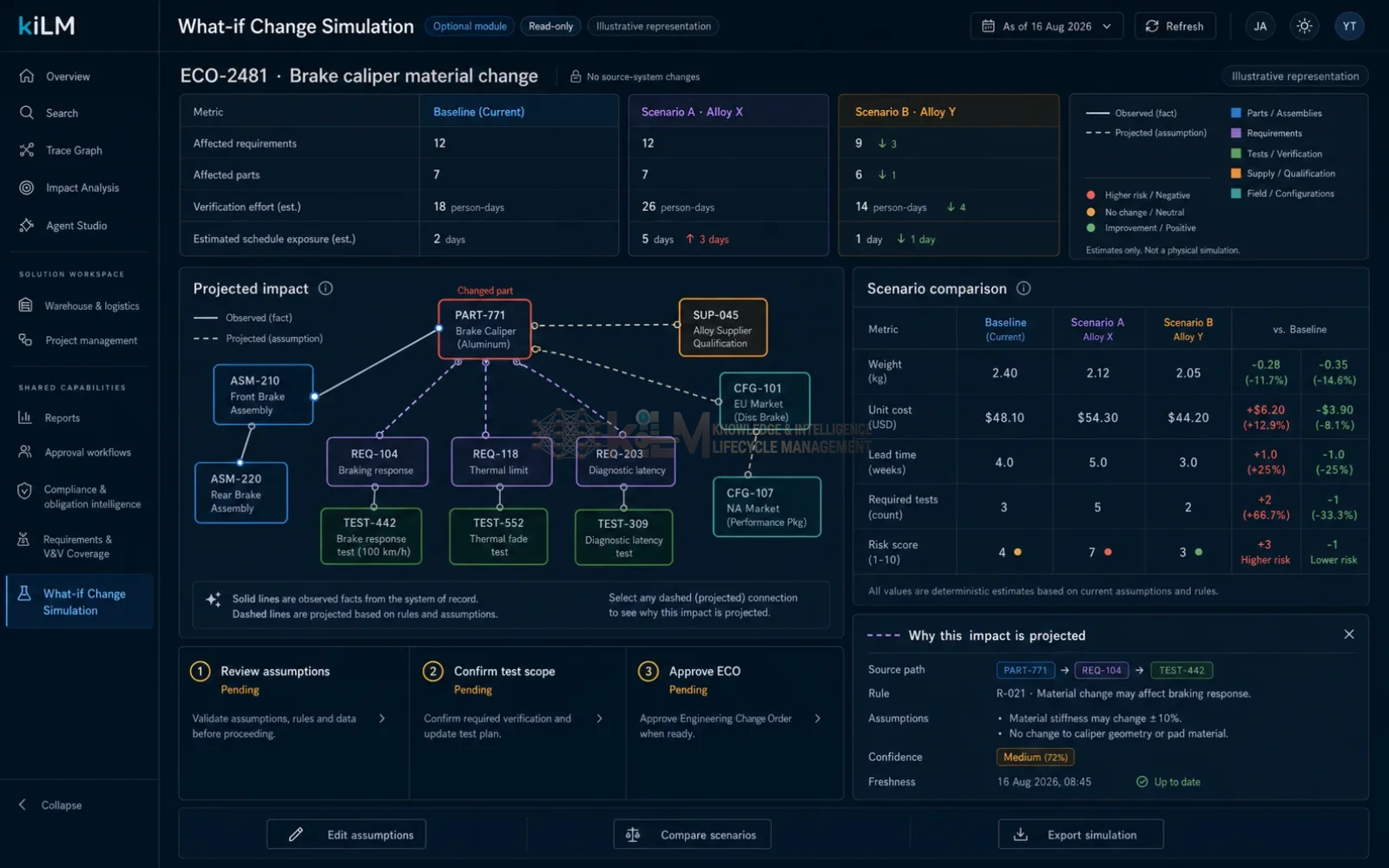
What-if Change Simulation
Model the effect of a proposed change and explore alternatives before you commit it.
How kiLM enables it
kiLM models the effect of a proposed change over the trace graph and BOM and lets you explore alternatives before you commit anything — entirely read-only.
Why kiLM is better placed
Scenarios run against your governed data without touching a system-of-record, so teams compare options safely and see downstream impact before an ECO is raised.
Possible features
- Read-only scenario modelling over the live dependency graph.
- Side-by-side comparison of alternative changes.
- Downstream impact preview feeding the change checklist.
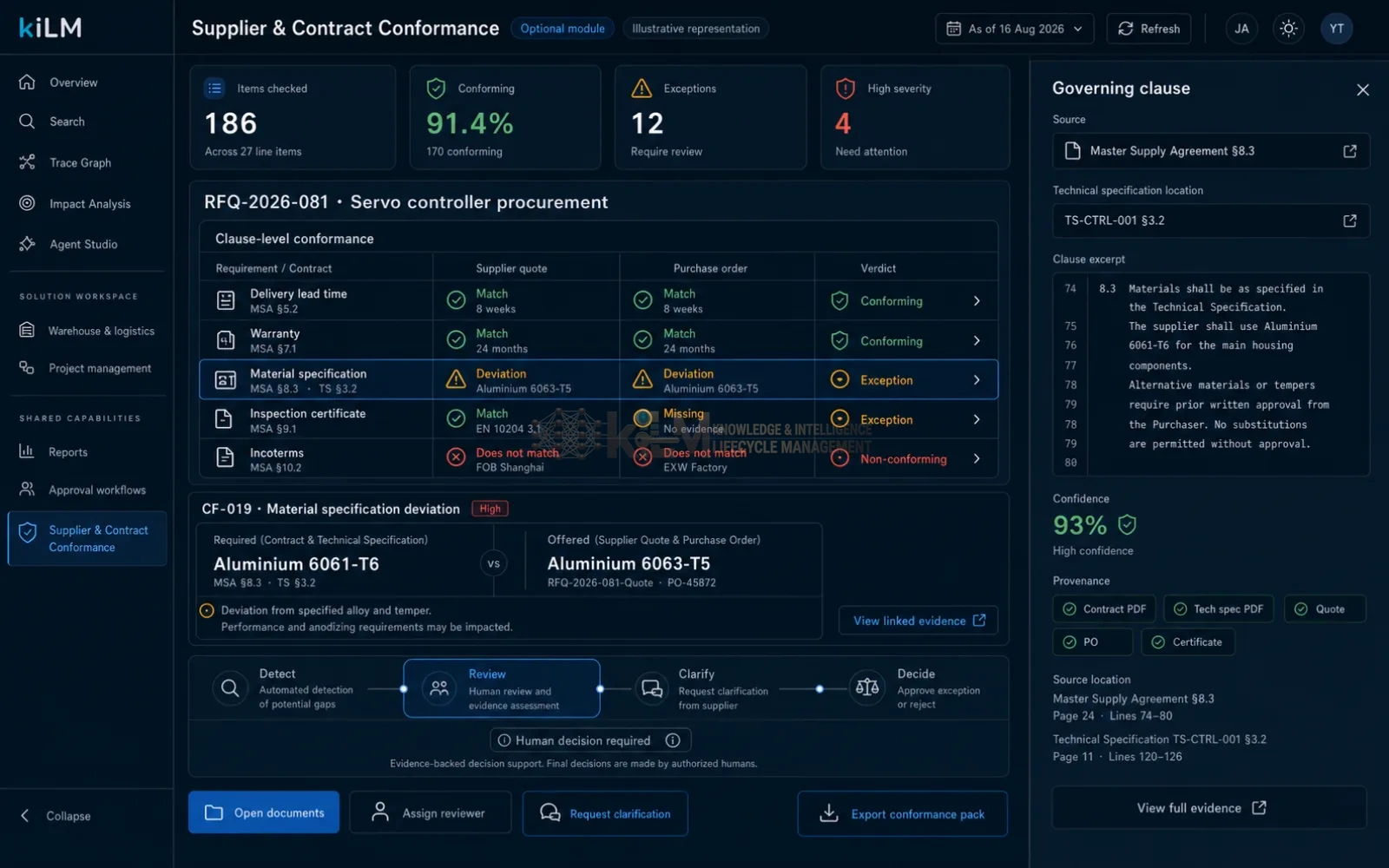
Supplier, Contract & Procurement Conformance
Check a supplier quote, purchase order or procurement record against the governing contract terms and specification for conformance.
How kiLM enables it
kiLM checks a supplier quote, purchase order or procurement record against the governing contract terms and specification, and reports where they conform or diverge.
Why kiLM is better placed
Conformance is judged against the actual contract and spec in your systems, with the clause behind every finding cited — not a reviewer's recollection.
Possible features
- Quote / PO / procurement-record checks against contract and spec.
- Clause-level divergence findings with citations.
- Flagged non-conformances routed for review.
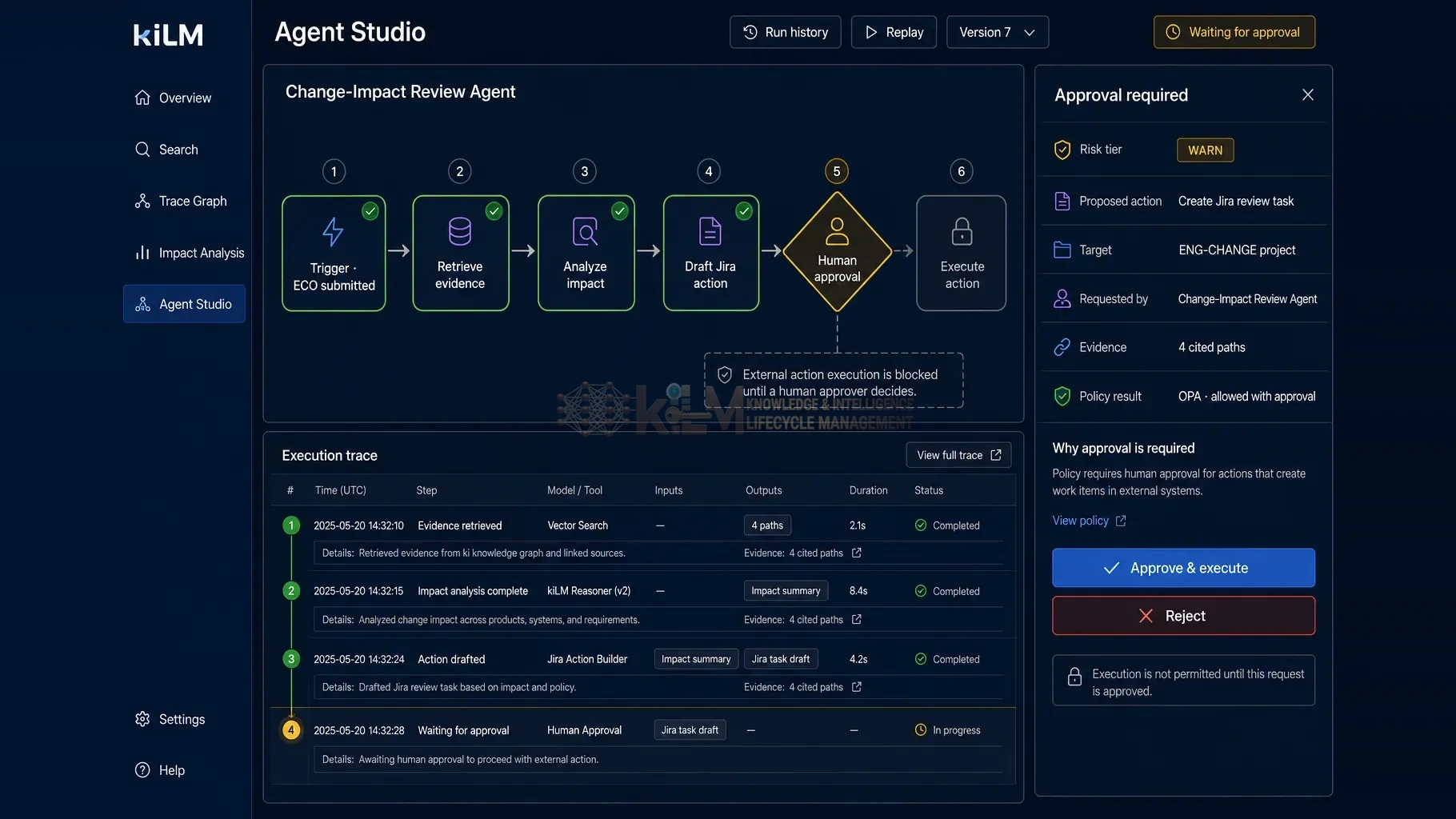
Cross-System Agentic Actions
Preview
Preview. The governance path for cross-system write-back is built — typed capabilities, policy-bound plans, approval before commit, compensation, and an append-only audit trail. Execution today runs against recorded fixtures: no live write to a connected system ships yet, and every simulated result is labelled as one. Live adapters are in development.
How kiLM enables it
kiLM plans write-back actions across your connected systems — create tickets, update records, trigger workflows — as typed, policy-bound capabilities that are proposed, approved and audited before any commit. In Preview those actions execute against recorded fixtures rather than live systems; the same plan runs unchanged once an approved live adapter is enabled for a connector.
Why kiLM is better placed
Actions are approval-gated, permissioned and fully audited, so you get automation without unrestricted autonomy — a human confirms before anything is written.
Possible features
- Approval-gated write-backs across connected systems — Preview: recorded execution today; live adapters not yet shipped.
- Per-action policy checks, permissions and full audit trail.
- Human-in-the-loop confirmation before any change.
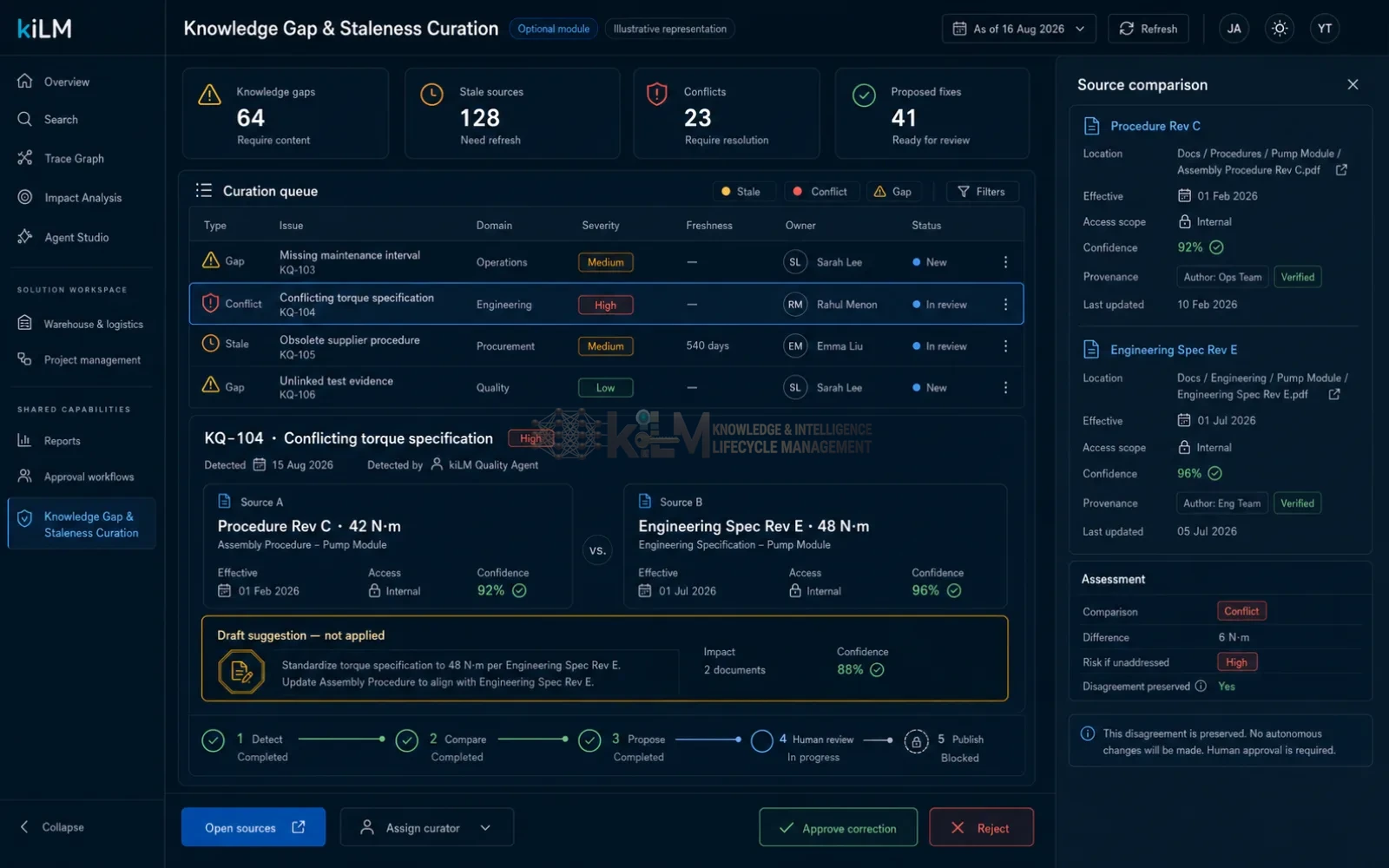
Knowledge Gap & Staleness Curation
Keep a self-healing Knowledge Base that surfaces missing, stale or conflicting content and proposes fixes for review.
How kiLM enables it
kiLM keeps a self-healing Knowledge Base that surfaces missing, stale or conflicting content and proposes fixes for review.
Why kiLM is better placed
Curation runs over your own governed corpus, so the base improves continuously without exposing content outside your boundary.
Possible features
- Detection of missing, stale and conflicting content.
- Proposed fixes queued for human review.
- Freshness and coverage signals over the corpus.
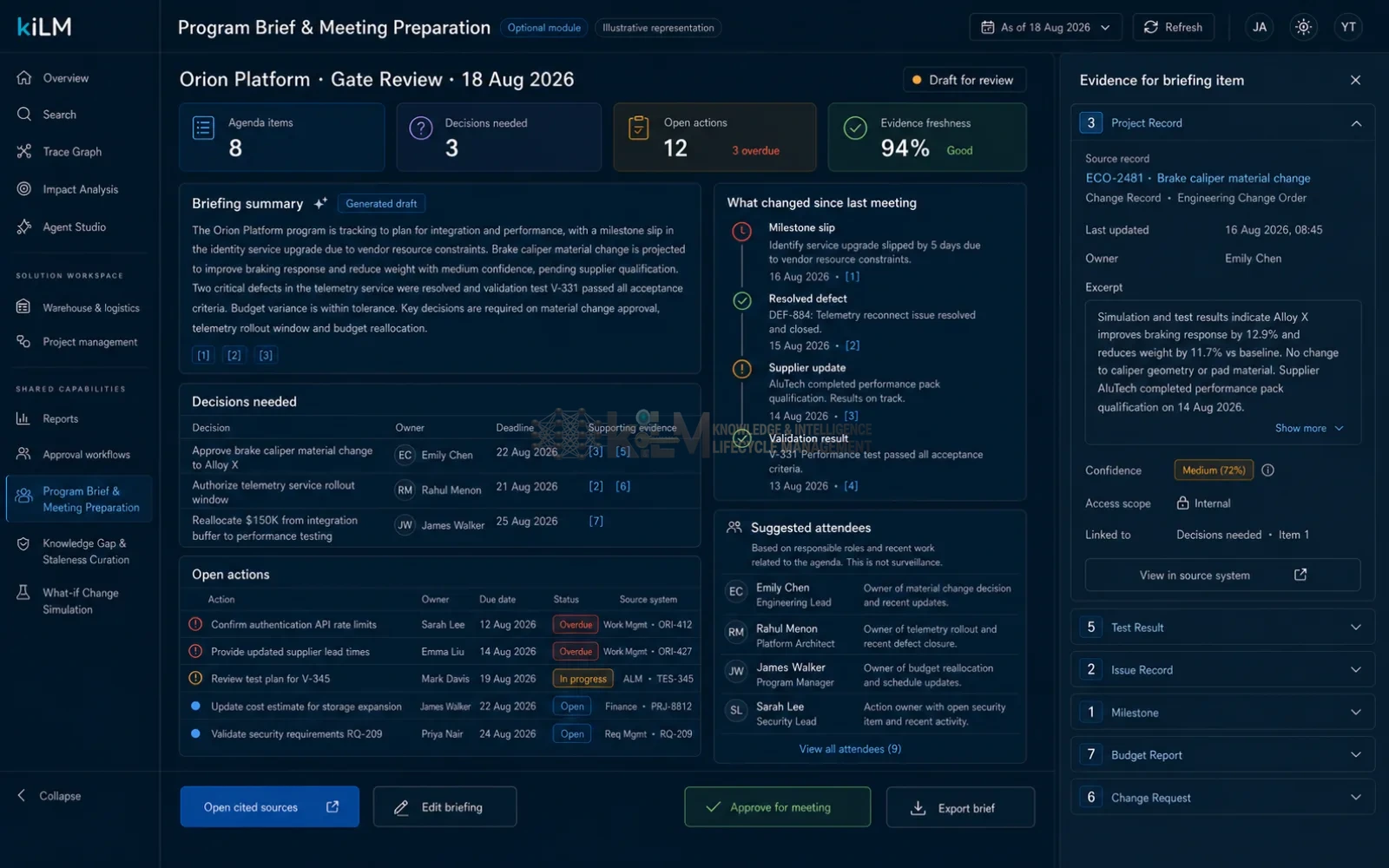
Program Brief / Meeting Preparation
Generate a scheduled, governed brief assembled from your corpus, metrics and knowledge graph, ready ahead of the meeting.
How kiLM enables it
kiLM generates a scheduled, governed brief assembled from your corpus, metrics and knowledge graph, ready ahead of the meeting.
Why kiLM is better placed
The brief is time-sensitive and operational — it pulls the latest governed state, so attendees walk in with a current, cited picture rather than last week's export.
Possible features
- Scheduled, meeting-ready briefs from live governed data.
- Cited highlights, risks and open items.
- Tailored to the program and its audience.
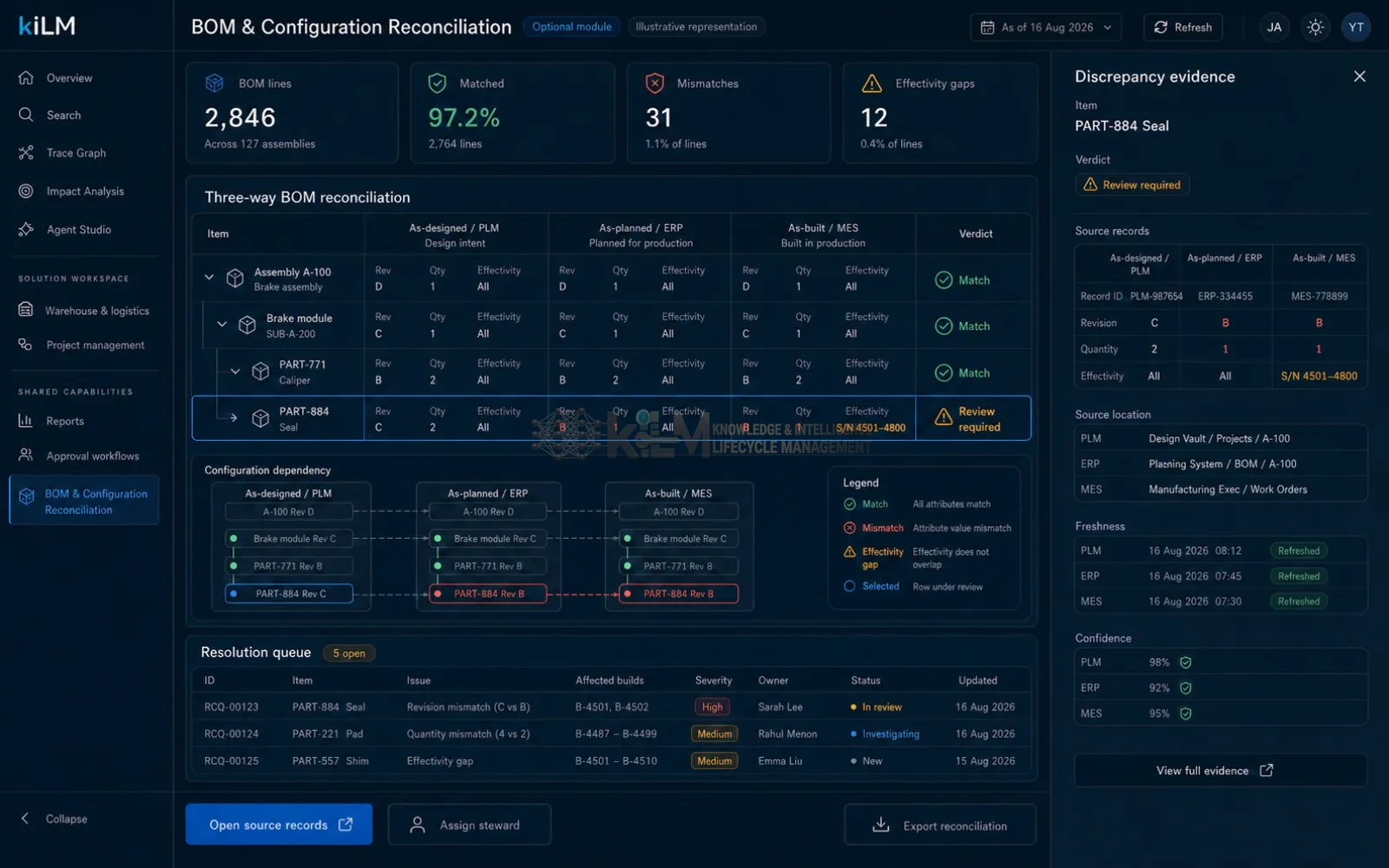
BOM, Configuration & Effectivity Reconciliation
Reconcile as-designed, as-planned and as-built BOMs across your systems, catching configuration and effectivity mismatches before they reach the floor.
How kiLM enables it
kiLM reconciles as-designed, as-planned and as-built BOMs across your systems and flags configuration and effectivity mismatches before they reach the floor.
Why kiLM is better placed
The comparison runs over your governed PLM / ERP / MES data inside your boundary, so mismatches surface early with the conflicting records cited — not discovered at assembly.
Possible features
- Three-way as-designed / as-planned / as-built BOM reconciliation.
- Configuration and effectivity mismatch detection.
- Cited discrepancies routed for resolution before build.
Put a Use Case to Work
Every use case here runs inside your deployment, on Infrastructure you choose. Tell us your stack and the decision you need to support, and we’ll help you scope the right starting point.